Link to my publications in ADS · full list on this site · CV
My work has two halves that feed each other. One is the physics of Alfvén waves in the solar wind, from Parker Solar Probe data to three-dimensional simulations. The other is infrastructure that lets AI agents do real science, with research supplying the ground truth. Each topic has its own page.
Alfvénons: Solitary Alfvén Waves in Three Dimensions
The large Alfvénic structures Parker Solar Probe meets near the Sun look solitary: a localized rotation of the field in an otherwise quiet corona. I construct them as a nonlinear solution of ideal MHD, the Alfvénon (Huang et al. 2026a). Now I collide them on GPUs to see how much of their energy turns into compressive waves.
LingTai 灵台: Lifelong Digital Scientists
An open-source runtime for research agents that hold a question for weeks, keep durable knowledge and skills as plain files, spawn specialists, and work together through a shared mailbox. I am its lead contributor and run my own research on it.
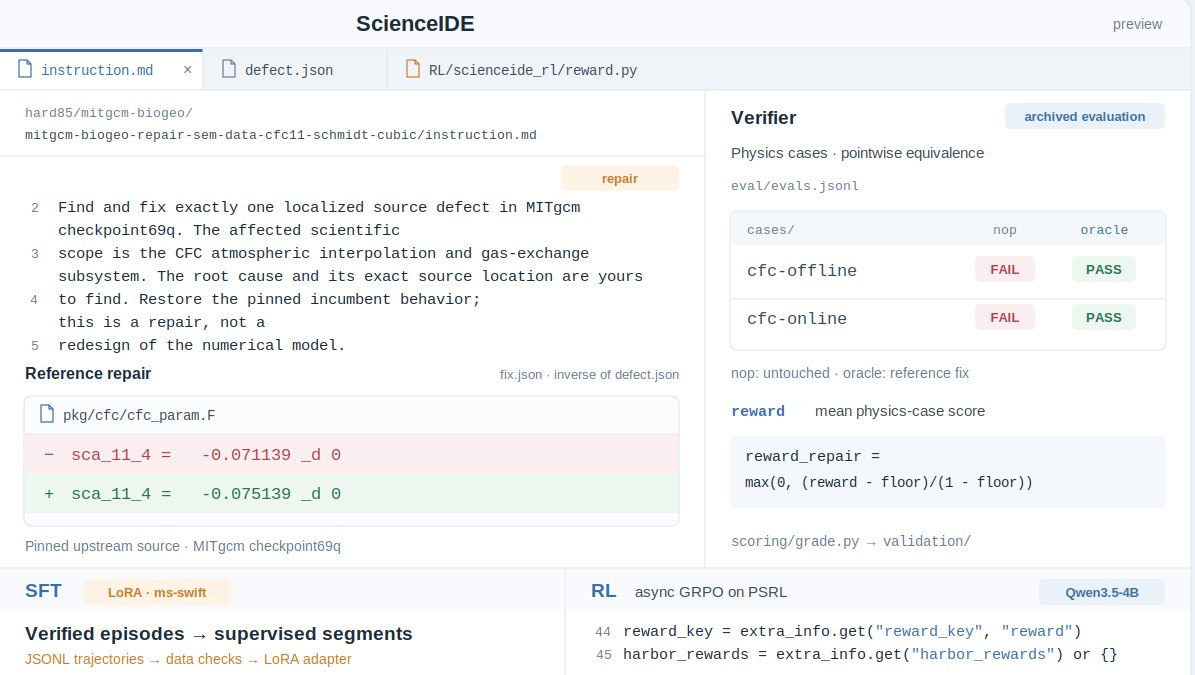
ScienceIDE: Scientific Codebases as Training Grounds for AI Agents
Pinned, unmodified scientific codes become executable environments. Agents repair or reimplement the source, and a verifier grades them by re-running the code's own physics cases. There are 64 environments from 27 codebases, used for evaluation, fine-tuning and reinforcement learning (Geng, Huang et al. 2026).
Agent Last Exam: Astronomy current
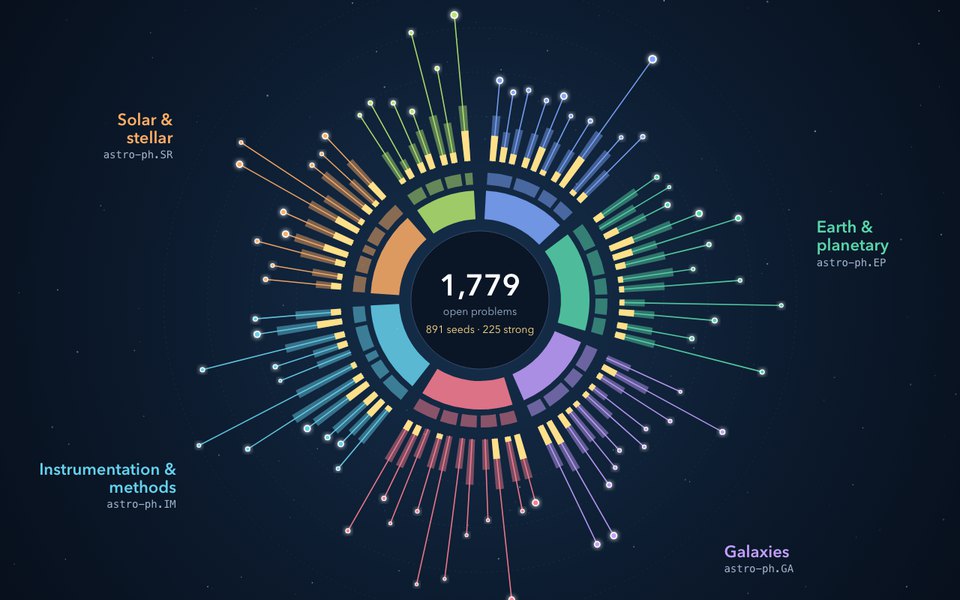
I lead the astronomy track of the Agent Last Exam. So far it has a map of the field's 71 research directions, 1,779 open problems harvested from the literature, and 891 seeds for tasks where an AI agent's method can keep improving against a sealed grader.
Solar-Wind Turbulence and Fine Structures
Where the solar wind's fluctuations come from and how they evolve: five-minute and two-minute oscillations reaching the wind, two kinds of 1/f range, the Gaussianity of |B|, and wave action in the expanding wind, with Parker Solar Probe, Solar Orbiter and Ulysses.

Research support
- Co-I, NASA ROSES-2024 AIAH: Solar Wind Structures Identified via Shannon Information Entropy, 2026–2027
- PI, NAIRR Pilot start-up: GPU-Accelerated PLUTO MHD Simulations of Alfvén-Wave Collisions, 2026 (SDSC Expanse)
- PI, NSF ACCESS allocation: Gaussianization of Magnetic Magnitude in MHD Turbulence, 2024–2025