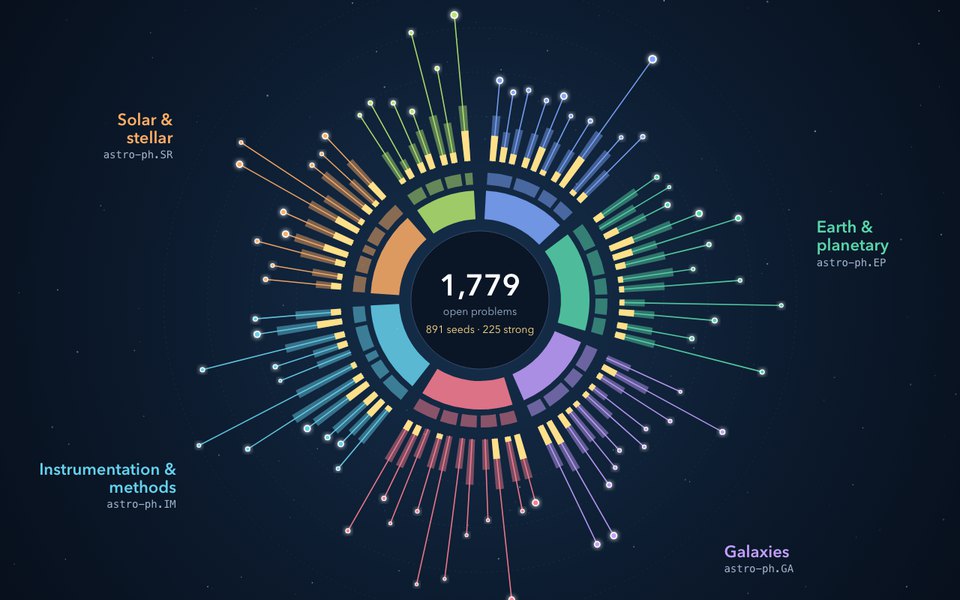
- The field as a star map. The inner ring holds the seven arXiv categories and the next ring their 32 areas. Each ray is one of the 71 research directions: its length is the number of open problems harvested for it, the gold base counts strong recursive-self-improvement seeds, and the pale band counts possible ones. Hover or tap a ray or an area for details; click a category, here or in the legend, to focus it. Counts as of October 2026.
Mapping the field
The Agent Last Exam asks whether AI agents can work on the open problems of a science. For astronomy we began with a map: a taxonomy that runs from the six astro-ph categories plus space physics, through 32 areas keyed to the IAU Divisions and Commissions, down to 71 research directions.
Harvesting open problems
For every direction, and then for every area as a whole, we harvested open problems from the current literature, with the cited sources checked. That gave 1,779 problems so far. Each is recorded with why it is still open, who cares about it, the state of the art, and what would count as the truth.
Which problems can become tasks?
We judged each problem against one question: can it become a recursive-self-improvement task? In such a task the agent submits a method as a script, and a sealed grader runs it on unseen scenarios. A single metric then says which method is better, and the metric leaves room to keep improving. 891 seeds passed, 225 of them rated strong. Each seed names its metric with units and direction, its naive, good and limiting values, its evaluator and its data.
- The same counts by arXiv category: open problems harvested (grey) and RSI task seeds judged from them, strong (dark) and possible (light).
From seeds to tasks
From the strongest seeds we are now building tasks on real survey data. One has grown into a project of its own: a GPU search of the Dark Energy Camera archive for distant, slow-moving bodies in the outer solar system.