Interactive: Switchback Explorer
Five-Minute Oscillations Reach the Solar Wind
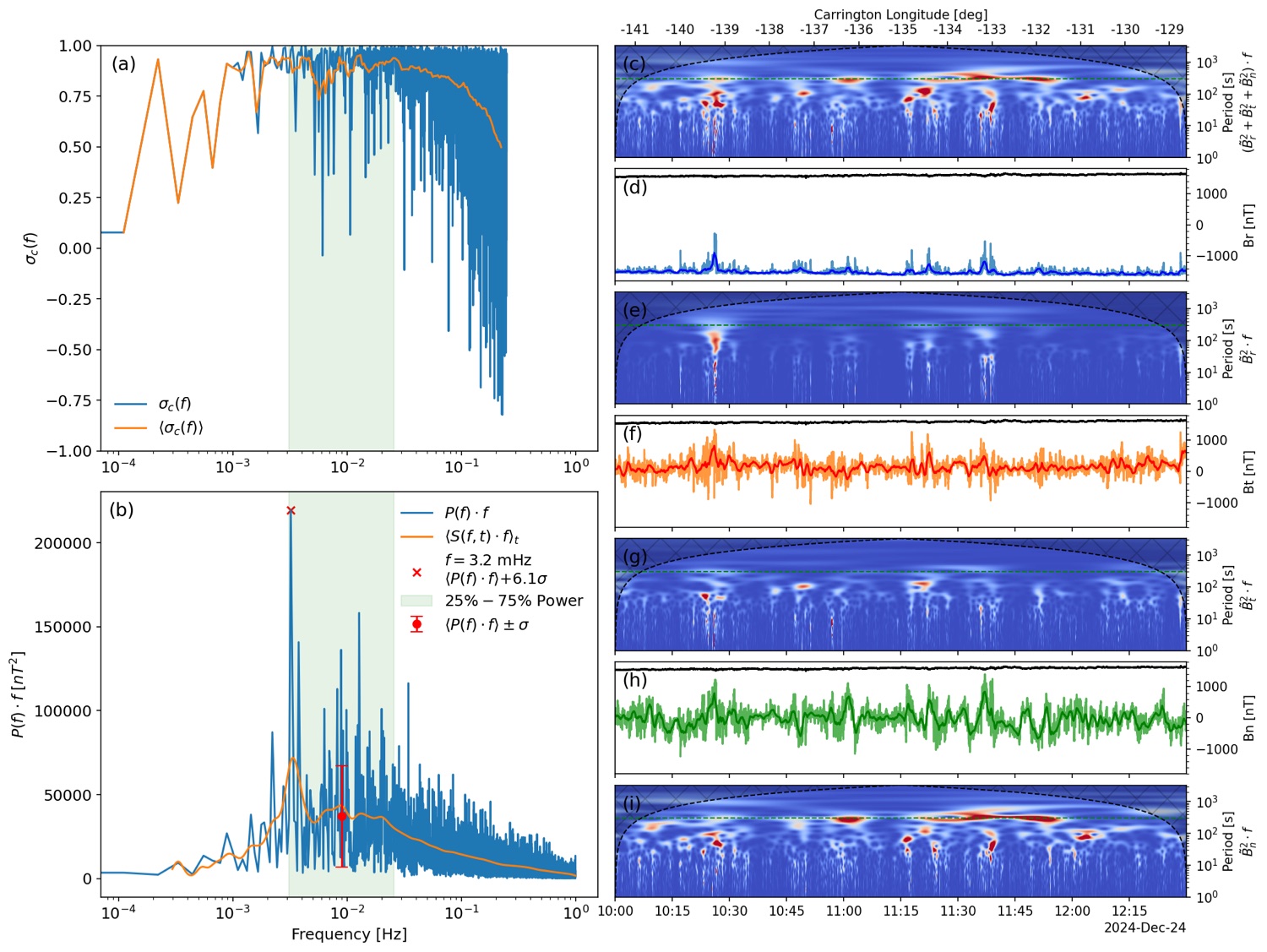
- Parker Solar Probe Encounter 22, 2024 December 24, at 9.9 R☉. (a) Normalized cross helicity σc(f); (b) magnetic power spectrum P(f)·f with a 3.2 mHz peak 6.1σ above the mean; (c–i) wavelet spectra and the R, T, N field components. From Huang et al. (2026b).
The Sun's surface rings with 5-minute p-mode oscillations, sound waves trapped in the convection zone. They have long been suspected of reaching the solar wind, but direct in situ evidence was missing. In Huang et al. (2026b) we present strong evidence from Parker Solar Probe's three closest perihelia. In two events at 9.9 solar radii, the magnetic power spectrum shows statistically significant (∼6σ) peaks at 3.1–3.2 mHz. Each appears as a large-amplitude, spherically polarized Alfvénic wave train lasting about 35 minutes: global solar oscillations do reach the solar wind.
Two-Minute Oscillations near the Alfvén Surface
Across the first 19 encounters of Parker Solar Probe, the fluctuation energy of the youngest solar wind is concentrated around 2-minute periods (Huang et al. 2024a). Wavelet spectrograms show these are mostly outward-propagating, spherically polarized Alfvén-wave bursts. A Doppler analysis maps their spacecraft-frame frequency back to the launch frequency at the base of the corona, where SDO/AIA sees a matching ∼8 mHz peak in the swaying of coronal structures. This is strong evidence that the waves originate in the solar atmosphere.
The 1/f Range: Two Origins
At the lowest frequencies the solar-wind magnetic spectrum follows 1/f before steepening into the inertial range. Closer to the Sun, Parker Solar Probe sees spectra much shallower than 1/f that evolve toward it as the wind ages, which points to a dynamic origin (Huang et al. 2023). Near the Alfvén surface the 1/f range is systematically absent above 10⁻⁴ Hz. Comparing many wind conditions, we found two distinct types of 1/f range (Huang et al. 2025). In fast, Alfvénic wind it is an intrinsic feature of Alfvénic turbulence and follows near-perfect WKB evolution. In slow and mixed wind it resembles classical flicker noise, which we traced across solar cycles 22–25.
Structures from the Gaussianity of |B|
We introduced the Gaussianity scalogram, a way to let in situ data contextualize itself (Huang et al. 2024b). Applied to the magnetic magnitude from Parker Solar Probe and Ulysses, it picks out possible remnants of solar structures across more than seven orders of magnitude in time scale, from years to seconds: polar and midlatitude coronal holes, and structures compatible with supergranulation, jetlets and picoflares. Simulations of Alfvénic turbulence reproduce the Gaussianization of |B| seen in the data. With NASA AIAH funding, these information-theoretic scalograms are now being developed into open-source software.
Total Wave Action in the Expanding Solar Wind
Wave action is not conserved when MHD wave modes coexist near β ∼ 1. We showed that the violation comes from mode conversion, through degeneracy, linear conversion or resonance, and that the total wave action summed over the interacting modes is still conserved. Expanding-box MHD simulations confirm this (Huang et al. 2022).
Collaborations
I am also a co-author of 14 refereed papers on switchbacks, intermittency, anisotropy, heating and turbulence, including Hou et al. (2026) in Nature Astronomy on the non-adiabatic entropy increase of the solar wind governed by velocity spikes. The publications page lists them all.