Solitary Alfvén waves in three dimensions
Parker Solar Probe found that the youngest solar wind is filled with large-amplitude Alfvénic fluctuations that look solitary. They are abrupt rotations of the magnetic field, up to full reversals (the "switchbacks"), set in an otherwise quiet coronal field, with nearly constant |B| and one-sided proton jets. The textbook nonlinear Alfvén wave, the spherically polarized Alfvén wave, defines its background field B₀ as the average of B. In spacecraft data that average is arbitrary: it changes even within a single solar-wind stream, and the Alfvén speed changes with it.
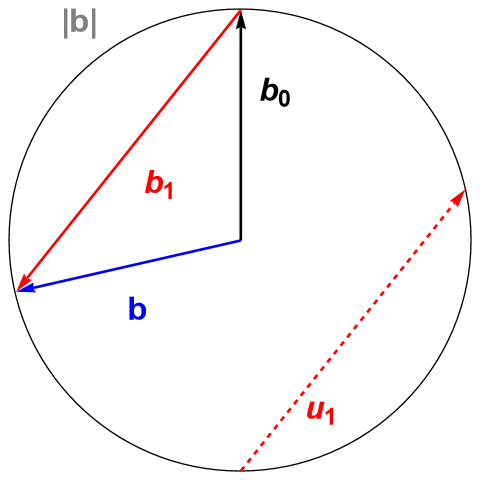
- The constant-|B| constraint: the wave field b₁ swings the total field b = b₀ + b₁ around a sphere of fixed radius; the flow u₁ is aligned with b₁. From Huang et al. (2026a).
In Huang et al. (2026a) we instead write the Alfvén wave as a solitary solution of ideal MHD: a localized perturbation riding on an unperturbed far field, with constant |B|. Building such a field in three dimensions is not trivial. It has to be divergence-free with open field lines exactly, keep |B| nearly constant, and leave the far field untouched. We construct it with an iterative algorithm that alternates a spectral Helmholtz–Hodge projection, which removes the divergence, with a normalization of |B|, and the iteration converges. We call the result an Alfvénon.
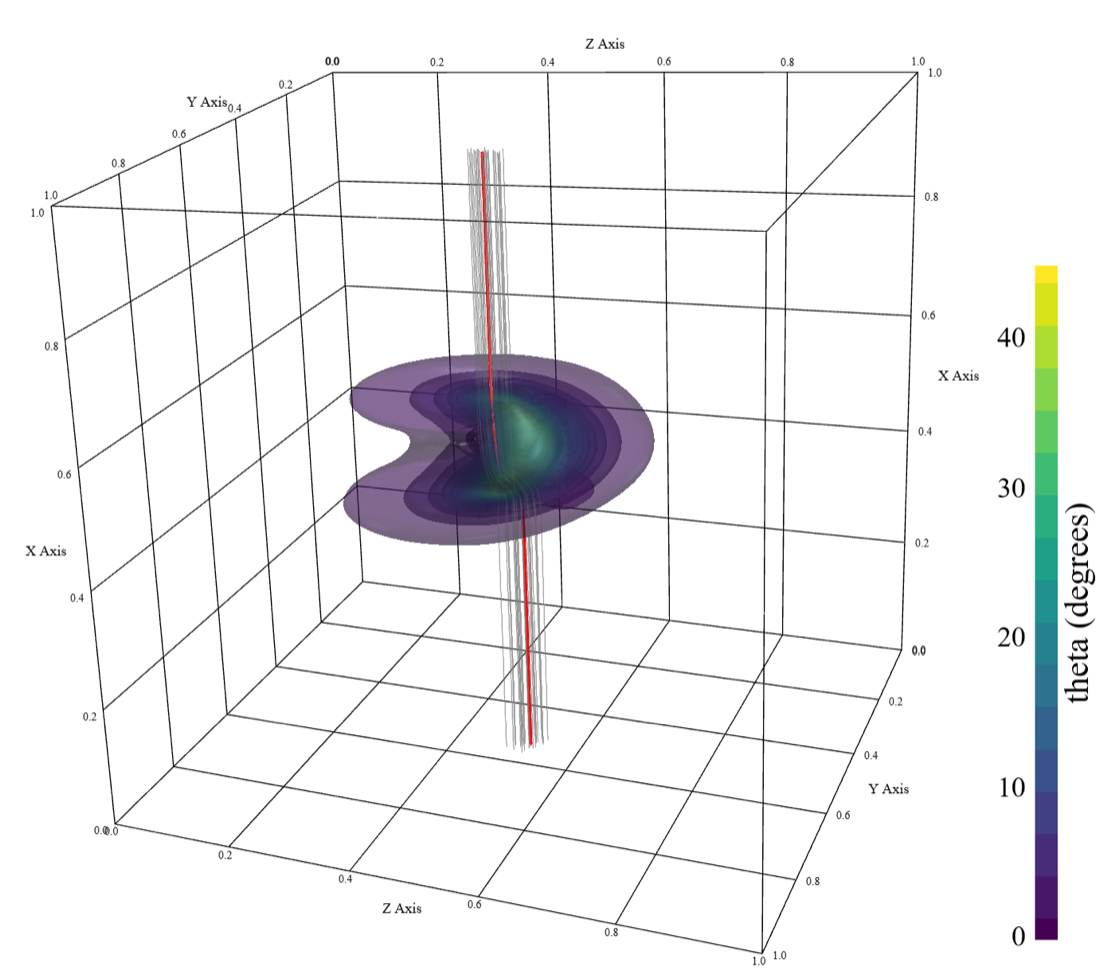
- An Alfvénon on a 128³ grid. Nested surfaces show θ = cos⁻¹(Bx/|B|), the angle between the local field and the unperturbed background field B₀ = x̂; it peaks at ≈45°. The grey field lines enter and leave the structure along x̂: the perturbation is localized, |B| stays nearly constant, and every field line stays open. From Huang et al. (2026a).
Direct MHD simulations with the pseudo-spectral code LAPS (β = 0.1, no explicit viscosity or resistivity) show the Alfvénon travelling at the Alfvén speed and holding its shape, with only mild relaxation. The perturbations stay Alfvénic in all three components, and total energy is conserved to about 10⁻⁹. The slow deformation comes mainly from phase mixing: VA varies by about 1% inside the Alfvénon. Small density fluctuations grow from minor defects of the constructed field, such as its slightly non-constant |B|. The Alfvénon behaves as a nonlinear solitary Alfvénic solution under ideal MHD.
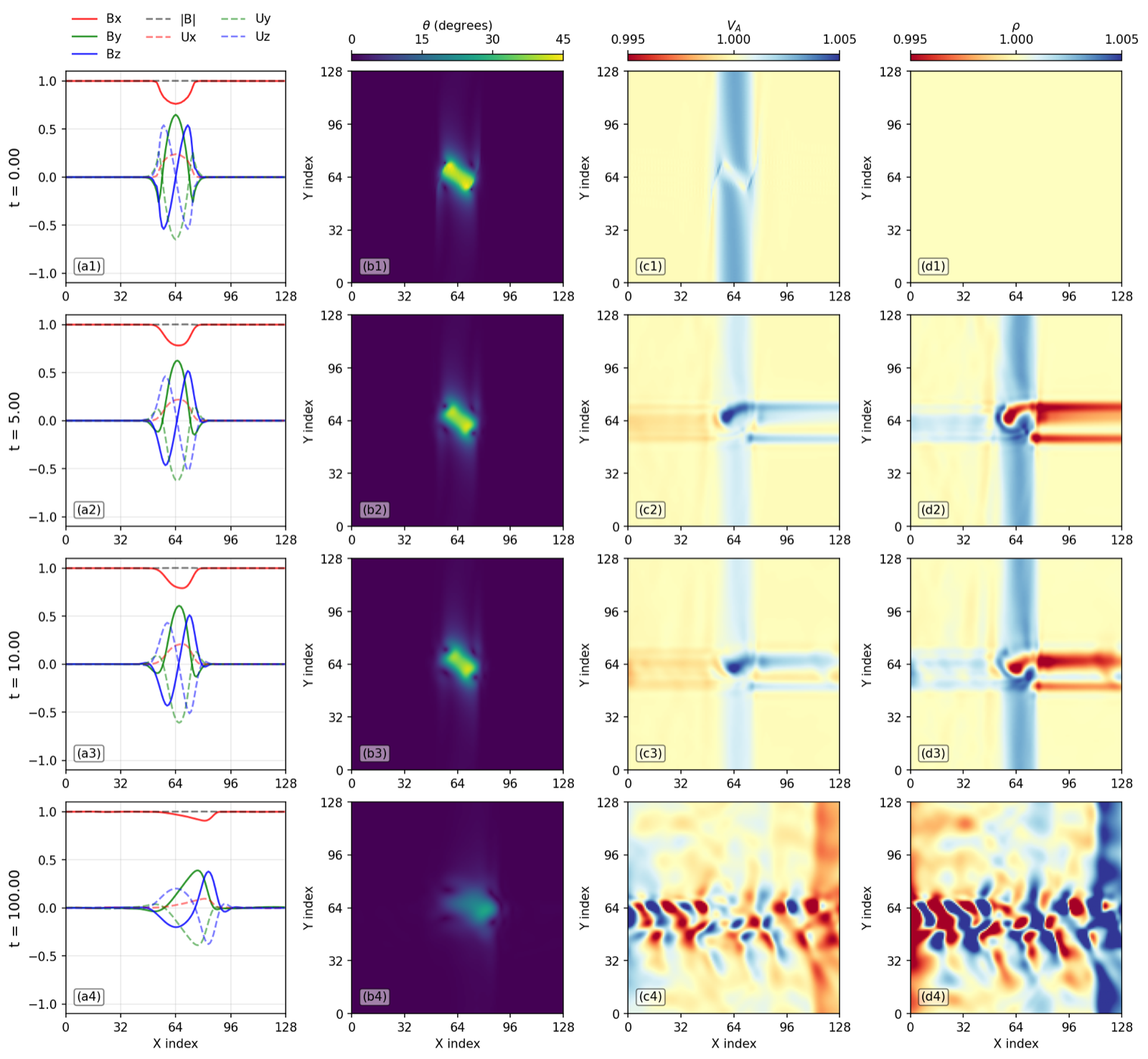
- MHD simulation of the Alfvénon at t = 0, 5, 10 and 100 (rows). (a) Profiles of B and u through the centre, shifted to a common position; (b) θ in the x–y mid-plane; (c) the Alfvén speed VA = |B|/√ρ; (d) density ρ. Note the colour scales of (c) and (d), which span only ±0.5%. From Huang et al. (2026a).
Colliding Alfvénons first results
Two small Alfvénons, colliding again and again
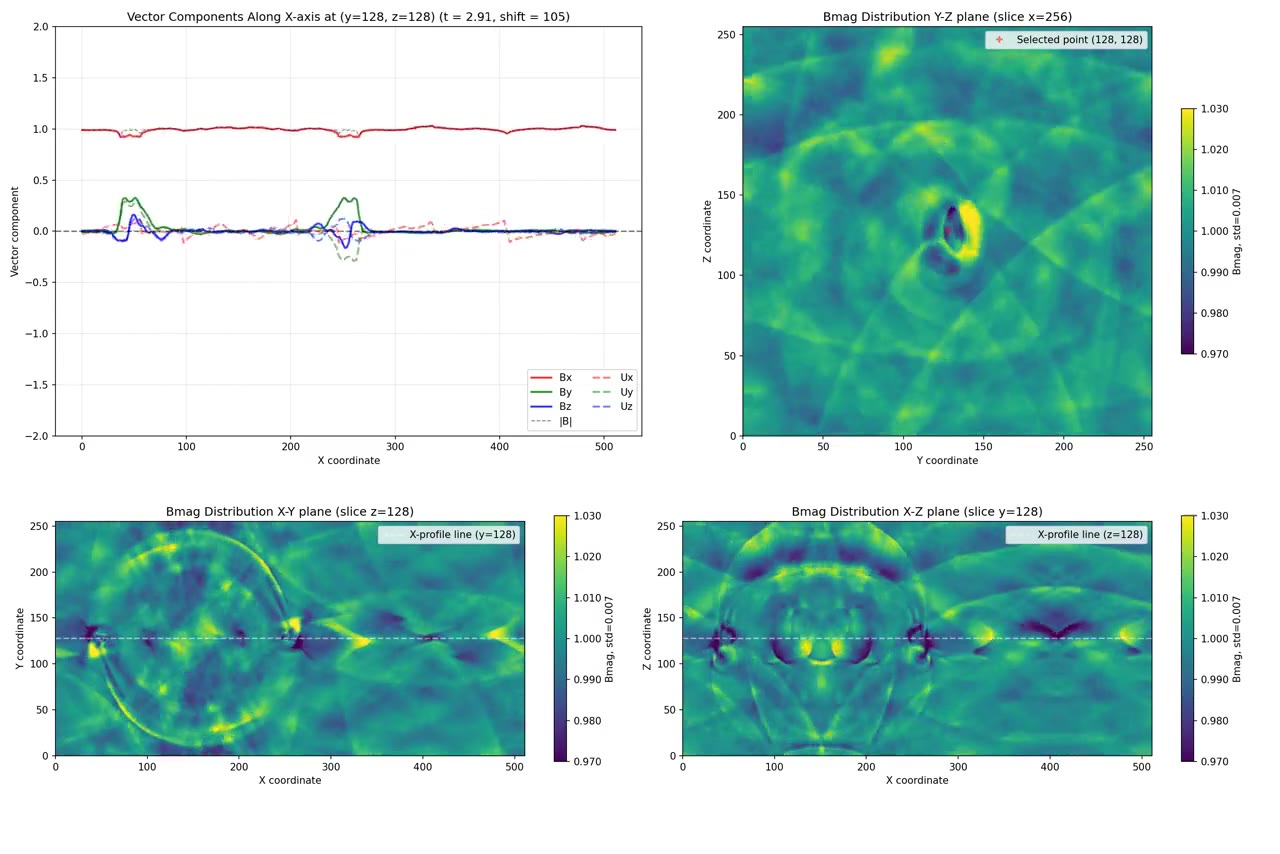
- Two small Alfvénons (θmax ≈ 45°) collide head-on, again and again, in a periodic 2×1×1 box. The simulation uses the pseudo-spectral MHD code LAPS on a 512×256×256 grid. Each Alfvénon alone has nearly constant |B|. Where the two overlap, |B| departs from 1 by a few percent, and the disturbance radiates away as expanding fronts of compressive waves. Top left: B (solid) and u (dashed) along x through the centre. Other panels: |B| in three mid-planes, t = 0 to 5.8.The same run, showing θ = cos⁻¹(Bx/|B|) from t = 0 to 78. The two Alfvénons pass through each other at every crossing of the periodic box and are slowly worn down. Top left: B (solid) and u (dashed) along x through the centre. Other panels: θ in three mid-planes. LAPS, 512×256×256.
A turbulent cascade needs counter-propagating Alfvén waves to collide, and the Alfvénon makes a clean collision experiment possible. An isolated Alfvénon carries no compressive component (δ|B| ≈ 0, δρ ≈ 0) and stays that way as it propagates. Any compressive energy that appears when two of them meet is therefore made by the collision. The mechanism is simple: each Alfvénon has constant |B| on its own, but their superposition does not. Where they overlap, a magnetic-pressure imbalance of order b₊·b₋ launches magnetosonic waves carrying a fraction of order (δb/B₀)² of the Alfvénic energy. That is order unity at the large amplitudes Parker Solar Probe sees near the Sun.
We are testing this with shock-capturing, double-precision GPU simulations of head-on collisions, on grids up to 1024×512×512, which conserve energy to better than one part in 10⁸.
The transfer grows with amplitude, and the packets come out of the encounter damaged rather than destroyed. Several things are now under way:
- matched single-packet and co-propagating controls, which separate collisional from numerical heating;
- an amplitude scan down to the ordinary-wave limit;
- collisions of Alfvénons with different shapes;
- a census of the fast and slow waves the collision emits.
Closed coronal loops, where reflection at the footpoints makes counter-propagating waves the rule, are the first application in view. A LingTai research agent helps run the campaign and keeps the record of every run.
Papers
- Huang, Z., Velli, M., Shi, C., & Ding, Y. 2026, “Solitary Alfvén Waves,” ApJL 1006, L20. doi · arXiv:2512.02292
- Huang, Z., Velli, M., & Ding, Y. 2025, “What are Switchbacks?” Crossings of Alfvénons with embedded rotational discontinuities give switchback-like field reversals. arXiv:2512.12585
- Ding, Y., Velli, M., Huang, Z., et al. 2026, “Spherically Polarized Alfvén Waves and the Gosling Boost.” arXiv:2608.05091
Code
- helmholtz-skill: the Helmholtz alternating-projection solver for divergence-free, constant-magnitude 3D fields (also Helmholtz_algo_public)
- alfvenon-pluto-cuda: a validated, open-source NVIDIA GPU port of PLUTO for the Alfvénon experiments
- LAPS: the UCLA pseudo-spectral, MPI-parallel 3D Hall-MHD code